Agrivoltaics and livestock farming: how does shading affect heat stress in animals?
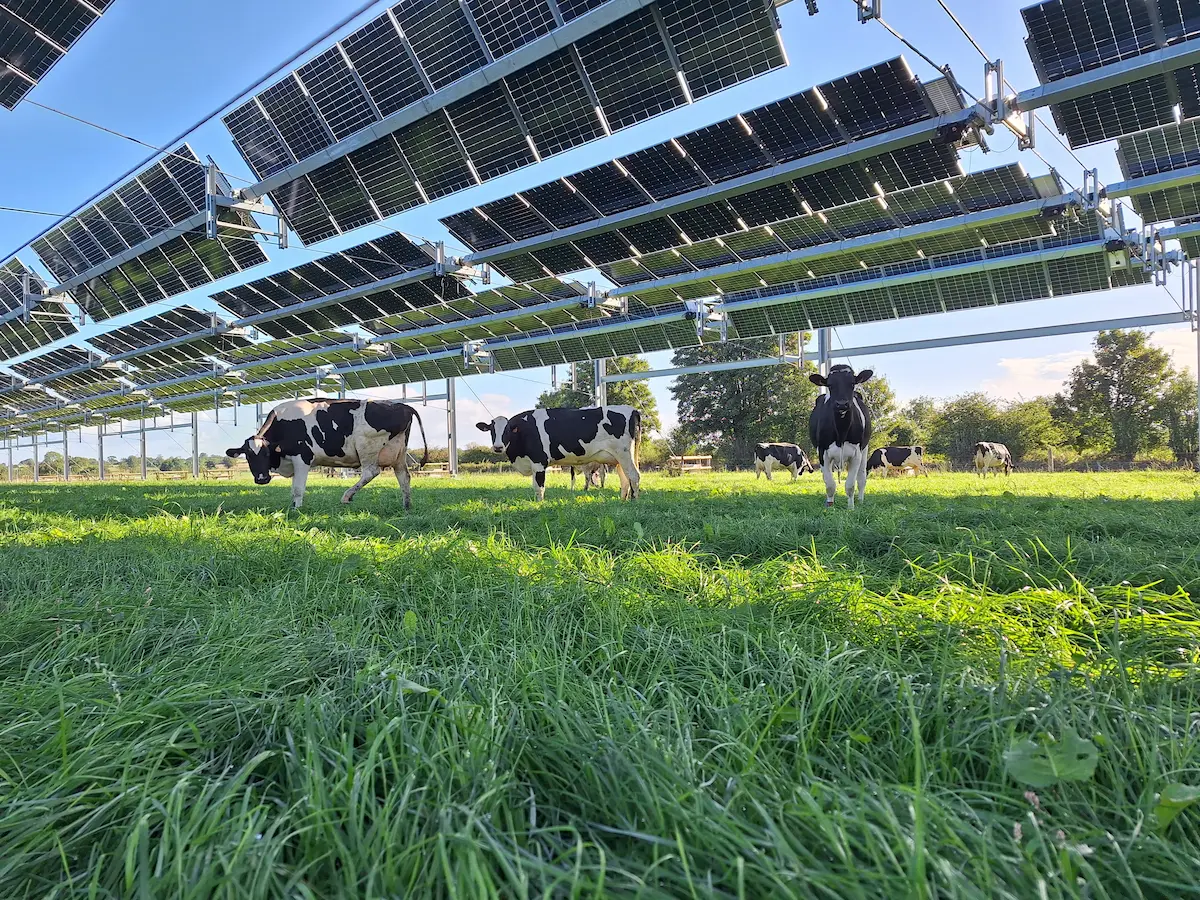

- The shade from solar panels helps limit animal exposureto the sun during periods of extreme heat.
- Climate measurements and animal monitoringmake it possible to assess the effects of shading on their comfort and performance.
- Measurements taken by TSE in Souleuvre-en-Bocageshow that cows with access to shade remained in the pasture until noon, compared to the control herd, which returned to the barn around 9:30 a.m.
- TSE's agronomic monitoring during the summer of 2026confirms that grass growth under the agrivoltaic installation was 99% higher than that of the control group, with comparable forage yield throughout the study.
How can agrivoltaics help my herd stay out at pasture during hot weather?
For livestock farmers, hot weather poses a practical question: how can animals continue to graze outdoors?
When temperatures rise, a herd may abandon a pasture where grass is still available to seek the shade of a barn. Air temperature alone is not enough to define the conditions to which animals are exposed: solar radiation also plays a role.
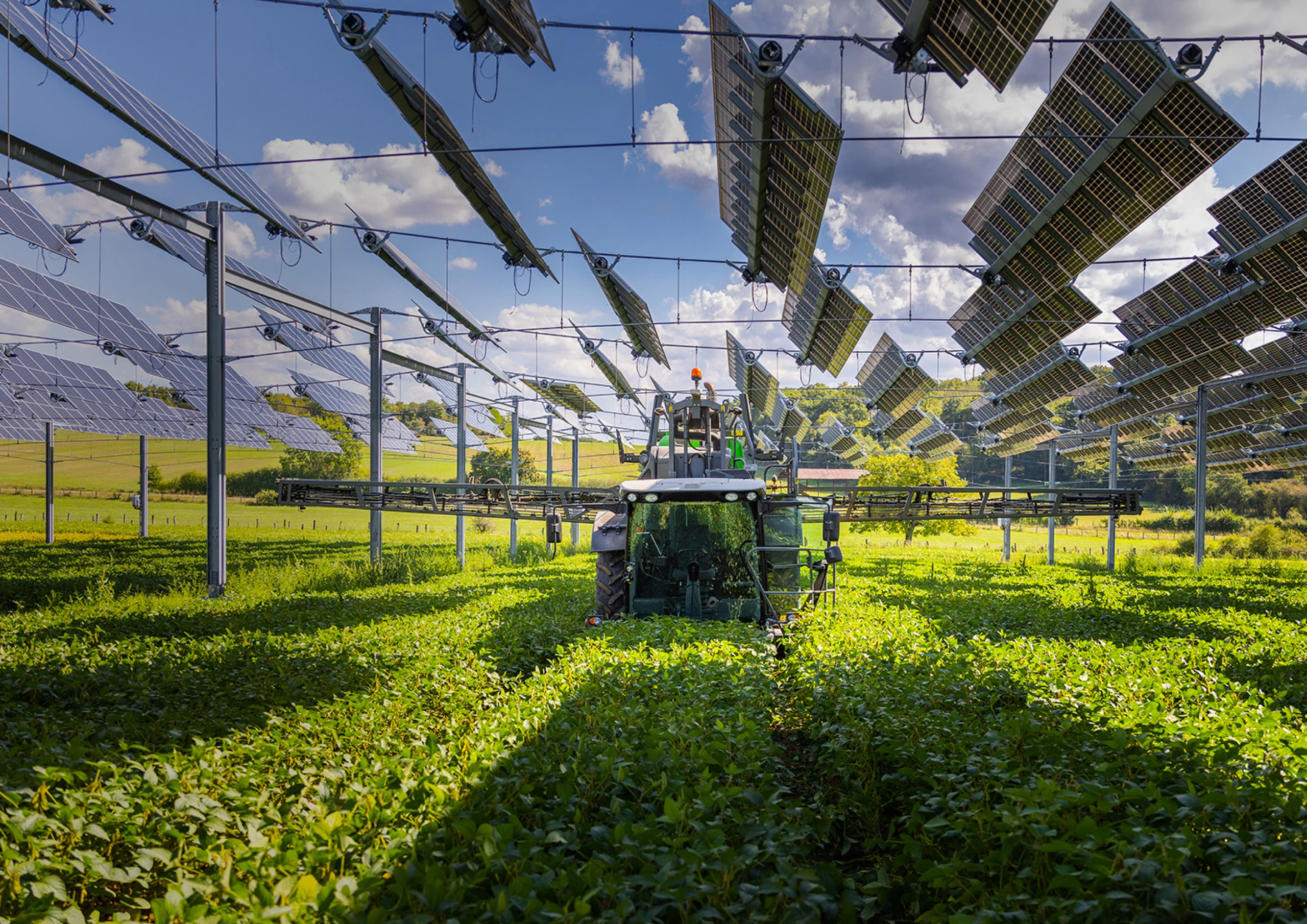
Agrivoltaics combines agricultural production with solar electricity generation on the same plot of land. Depending on the agrivoltaic project, solar panels can be installed above crops or grazing pastures. In the case of livestock farming,the panels provide shade for the animals.
With hot weather arriving earlier, becoming more frequent, and lasting longer, what effect can this shade have on animals? To answer this, we must distinguish between what is measured in the pasture and what is observed in the animals themselves.
What is heat stress in animals?
An animal produces its own body heat and also receives heat from its environment.Heat stress occurs when the animal struggles to dissipate this heat. A humid, windless day can be difficult to endure, even if the air temperature does not seem extreme. In direct sunlight, solar radiation further increases the heat load.
How can you spot it in a herd? Animals seeking shade, drinking more, breathing faster, eating less, or changing their resting habits can be warning signs. These indicators should not be interpreted in isolation: they depend on the species, age, condition of the animals, and the duration of the heatwave. In dairy cows, prolonged heat can also affect milk production.
How is heat stress in animals measured?
It is necessary to distinguish between the thermal conditions measured around the animals and the animals' response to those conditions. To describe their environment, four key climatic parameters are recorded:
- temperature,
- air humidity,
- direct and indirect radiation,
- and air speed.
Indices are calculated based on these parameters, such as theTHI(Temperature Humidity Index), which takes into account air temperature and humidity to help detect stress. However, this index is not exhaustive.
TheHLIThe Heat Load Index (HLI) is more comprehensive, as it incorporates four parameters: temperature, humidity, solar radiation, and wind. It is therefore better suited for mapping thermal comfort for animals, particularly under solar panels. It is an indicator that the French Livestock Institute (Idele) is studying as part of its work on agrivoltaics and agroforestry.
Finally, theWBGTWet Bulb Globe Temperature (WBGT) is another index that combines temperature, humidity, radiation, and ventilation. It is primarily used to assess human heat exposure in the workplace, which is the context in which the INRS (National Research and Safety Institute) presents it. While similar in principle to the HLI, it remains designed for humans: its thresholds cannot be directly applied to animals.
What observations have been made regarding the cattle in Souleuvre-en-Bocage?
In Souleuvre-en-Bocage, Calvados, dairy cows are grazing under an agrivoltaic installation monitored byTSE, the Calvados Chamber of Agriculture, and the French Livestock Institute (Idele). A control zone without solar panels serves as a point of comparison. This setup allows for the monitoring of heat conditions, animal behavior, and milk production performance.
On a hot July morning in 2026, at 10:00 a.m., TSE recorded a WBGT of 27°C in direct sunlight and 22°C under the panels. The result shows a 5°C WBGT difference between the two locations at the time of measurement.
On July 7, 2026, between 9:30 a.m. and 10:30 a.m., the TSE teams measured an air temperature of 25.9°C under the agrivoltaic system, compared to 27.1°C in the control area.
And what do the cows do when it’s hot?According to the observations published by TSE, the cows in the pasture without shade returned to the barn around 9:30 a.m., while those benefiting from the shade of the agrivoltaic system remained in the pasture until their usual return time, around noon.
Yoann Bizet, the farmer, reports:
"When the temperature climbs, the cows without shelter head into the barn to find shade, while the others continue to graze: the animals' heat stress is limited and their comfort is increased," he summarizes.

Monitoring of milk performance also shows results maintained at the same level as the control group without panels. This applies to thequantity of milk produced, its protein and fat content, as well as the somatic cell count in the milk..
{{cta-contact-agri}}
Does the agrivoltaic shade structure also affect the pasture during heatwaves?
For animals to continue grazing, grass must remain available. The effects of shading on its growth can vary depending on the composition of the pasture and the type of agrivoltaic installation, particularly the panels (fixed or mobile).
Specifically,the monitoring carried out by TSEshows greater pasture resilience under the agricultural canopy during certain dry periods.
In the summer of 2026,grass growth was 99% higherthan that of the control group without panels, meaning nearly twice as much grass. The differences observed during dry summer periods were+53% in 2025 and +92% in 2024..
Field observations illustrate this difference: in 2026, by July, the control pasture had dried out and stopped producing, while the area under the canopy continued to produce and remained green into August.
Over the entire monitoring period, forage yield under the canopy remained comparable to the control, with more grass produced during the dry summer. For the farmer, the benefit is having grass available for grazing during a time when it might otherwise be scarce.
Under the conditions monitored in Souleuvre-en-Bocage, the observed benefits apply to both the animals and the pasture:the shade offers the cows protection against direct sun exposureand contributes topreserving forage resources during the dry season.
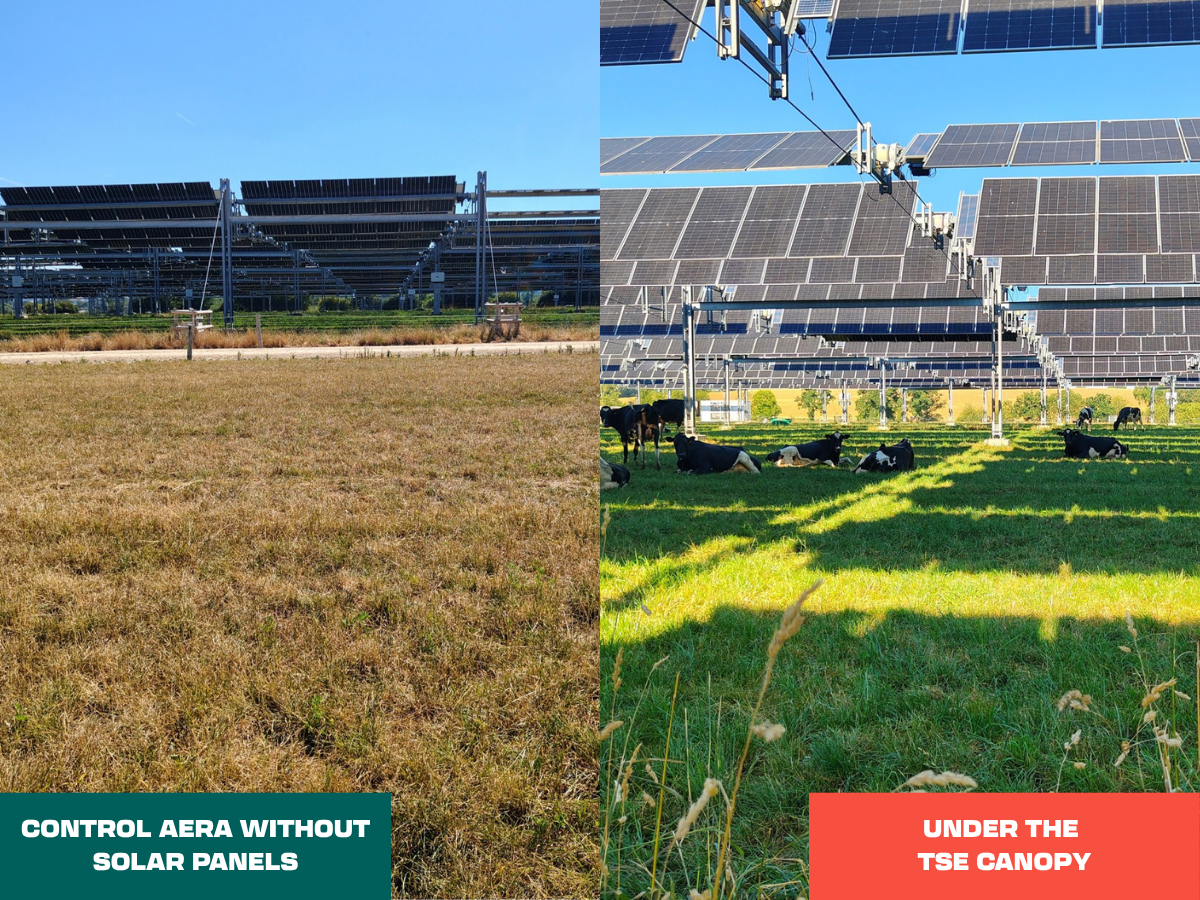
Left: grass is dry, no shade, no cows in the field.
Right: green grass, cows lying in the shade.
Are cattle, sheep, and goats all affected by heat stress?
Yes, but their sensitivity and ability to adapt are not the same.
For dairy cattle, production level, breed, physiological stage, and farming conditions all influence their vulnerability to heat.
Sheep and goats have different thermoregulation capabilities, but they too can be affected by high temperatures.
In goats, for example, the Livestock Institute reports potential effects on reproduction.
The livestock shade structure developed by TSE is designed for cattle, sheep, and goats in rotational grazing systems. The principle remains the same: providing animals with shaded areas while maintaining the agricultural use of the pasture.
Is the shade from the panels enough to eliminate heat stress?
The shade from solar panels helps limit heat stress by reducing the animals' direct exposure to the sun. However, it is not enough to eliminate it entirely.
Before choosing an agrivoltaic solution, verify that it provides shading suited to your herd's needs and is compatible with your farming practices. For example, the clearance height under the panels and the spacing between the posts must allow for animal movement and the passage of machinery used for pasture maintenance or mowing.
{{cta-article-2}}
FAQ - Agrivoltaics and the effect of shading on animal heat stress
Sources:
- Livestock Institute, "Heat stress in livestock farming: understanding and acting against high temperatures" report (2026).
- Livestock Institute, "High temperatures in goat farming: adapting herd management" (2026).
- TSE,The livestock shade structure, a solution for cattle, sheep, and goats.
- TSE,LinkedIn post on WBGT measurements in Souleuvre-en-Bocage (July 2026).
- TSE, press release " TSE Agrivoltaics: excellent 2026 agronomic results " (September 18, 2026).
- TSE, " In Calvados, Yoann Bizet's agricultural canopy shows promising results " (September 29, 2025).
- Institut de l’Élevage and INRAE, "Heat stress and goat reproduction" (2026).
- Institut de l’Élevage, "Drought: watering animals when water resources are at their lowest".
- INRS, "The role of the WBGT approach", Occupational Health References (2025).
- Institut de l’Élevage, "Pat’Stress: monitoring grazing animals via a multi-sensor device" (2026).