Agrivoltaics: what regulations guarantee and require for projects in France
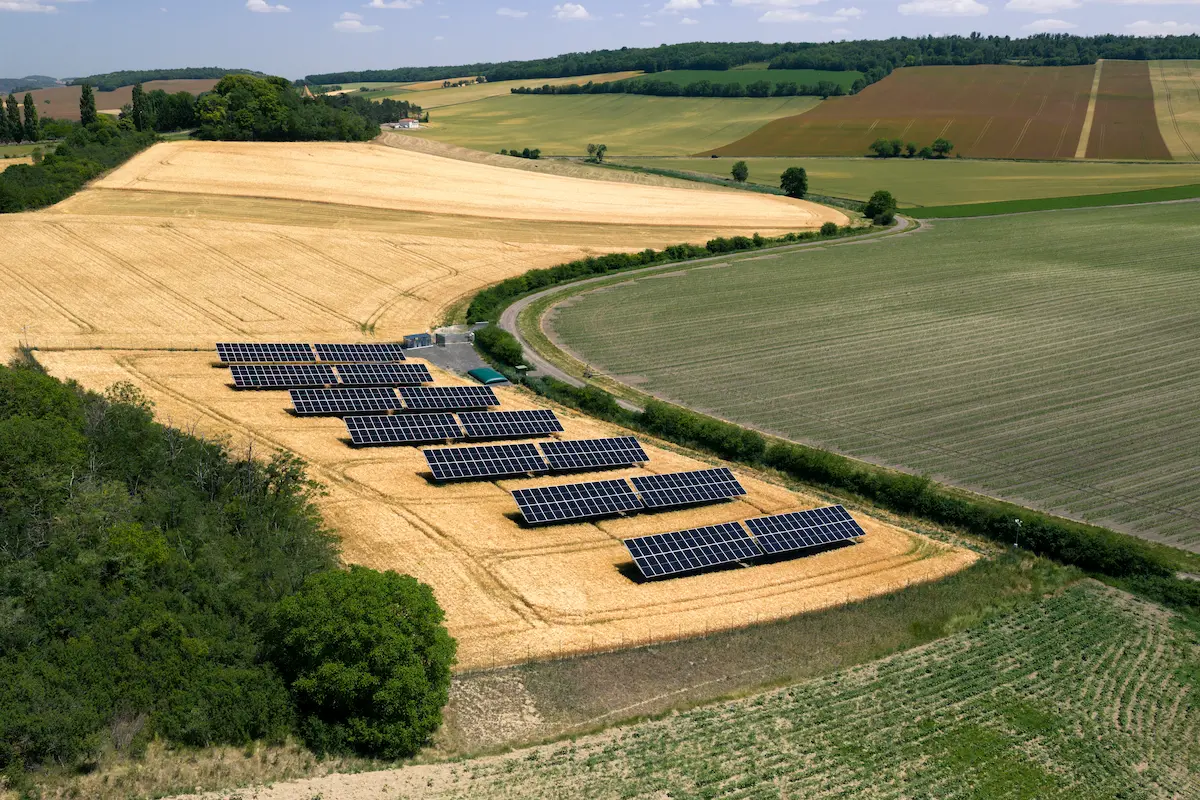

- Agriculture must remain at the heart of the project : the installation must provide at least one service to the agricultural activity and allow for the maintenance of significant agricultural production.
- Agricultural production is regulated and monitored : it is assessed, in particular, by comparison with a control area or a reference framework in accordance with the conditions stipulated by regulations.
- The layout of the panels is regulated : the surface area rendered unusable, spacing, height, and coverage rate must allow for the continuation of agricultural activity.
- Compliance with the criteria is monitored over time : the installations are subject to monitoring throughout their operation and must be reversible at the end of the project.
What rules must an agrivoltaic project follow to protect agricultural activity?
Since 2023, agrivoltaics has had a specific legal framework in France. The APER Act of March 10, 2023 established for the first time a definition of agrivoltaics in the Energy Code.
This definition was subsequently clarified by the decree of April 8, 2024, which sets out criteria for assessing the maintenance of agricultural activity and the conditions for installing facilities.
For a farmer considering an agrivoltaic project, the challenge is to answer one essential question: what rules must this project follow to be classified as agrivoltaic ?
Services provided to agriculture, maintaining significant agricultural production, primary agricultural activity, control plots, coverage rates, monitoring, and reversibility: here are the main rules to know and what they mean in practice for a project.
To better understand the implementation of this framework and the contributions of the April 8, 2024 decree, also check out our analysis of the agrivoltaic regulatory framework below.
{{cta-article-1}}
What conditions must a project meet to be considered agrivoltaic?
The APER Act establishes a fundamental distinction: installing solar panels in fields is not enough to qualify as agrivoltaics.
Article L.314-36 of the Energy Code, introduced by the APER Act, defines an agrivoltaic installation as an electricity production facility using solar energy whose modules are located on an agricultural plot and contribute sustainably to the establishment, maintenance, or development of agricultural production.
To meet this definition, the project must, among other things, provide a service to agriculture, guarantee significant agricultural production and sustainable income, ensure that agricultural activity remains the priority on the plot, and be reversible.
A solar project located on agricultural land is therefore not automatically an agrivoltaic project. It must meet all the criteria set out by the regulations.
What services must an agrivoltaic project provide to the agricultural plot?
The APER law requires that the installation directly provide a service to the agricultural plot.
To be classified as agrivoltaic, the installation must provide at least one of these four services directly to the agricultural plot.
The service required therefore depends on the farm and its specific needs: the crops grown, exposure to climate risks, agronomic challenges, or livestock conditions.
An agrivoltaic project must not only allow agricultural activity to continue, it must also demonstrate the service it provides to that activity.
What are the main technical criteria to be met?
The decree of April 8, 2024, clarified the APER law by establishing several criteria to ensure that agricultural production is significant and remains the primary activity on the plot.
Maintaining significant agricultural production
For non-livestock agrivoltaic installations, Article R.314-114 of the Energy Code stipulates that agricultural production is considered significant when the average yield per hectare of the agrivoltaic plot is greater than 90% of the yield observed in a control area or a reference standard provided for by the regulations.
This threshold therefore makes it possible to compare the agricultural performance achieved with the installation against a reference situation.
And what about agrivoltaic installations with livestock?
Article R.314-116 of the French Energy Code stipulates that the significance of agricultural activity can be assessed, in particular, with regard to the volume of forage biomass, stocking rate, or digital productivity rate. The evaluation methods are then specified according to the type of livestock farming and land use.
Regulations therefore adapt the assessment of agricultural production to the reality of the farm: maintaining livestock activity is not evaluated in the same way as crop production.
Preserving sufficient arable land
Regulations also provide that the area rendered unusable by the installation must not exceed 10% of the total area covered by the agrivoltaic installation.
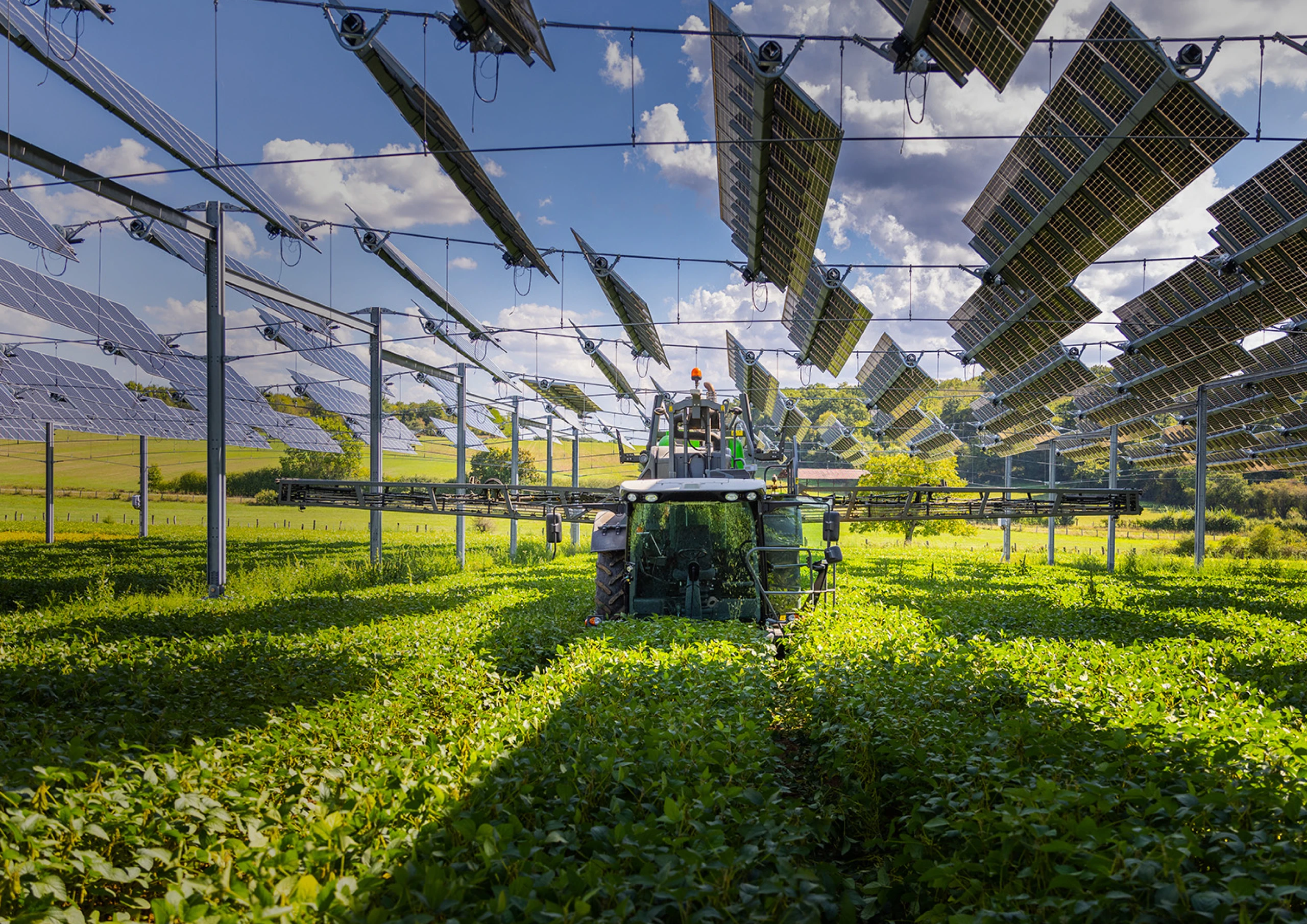
Article R.314-118 of the Energy Code also requires that the height of the equipment and the spacing between rows allow for normal operations: the movement of animals and, where plots are mechanized, the passage of agricultural machinery.
Regulating the coverage rate
Finally, regulations govern the portion of the plot covered by photovoltaic modules.
For installations exceeding 10 MWp that do not fall under the proven agrivoltaic technologies provided for by regulation, Article R.314-118 of the Energy Code sets a maximum coverage rate of 40%.
These various criteria share the same objective: to enable electricity production while maintaining conditions compatible with effective agricultural activity.
What is a control zone in agrivoltaics?
A control zone is a reference agricultural area used to compare the yields obtained on a plot covered by an agrivoltaic installation with those of a comparable situation without photovoltaic panels.
For agrivoltaic installations not involving livestock, regulations require the use of a control plot to verify that significant agricultural production is maintained.
Article R.314-114 of the Energy Code specifies that it must be located near the installation, have equivalent soil and climate conditions, and be cultivated under the same conditions as the agrivoltaic plot. It must not contain photovoltaic modules or any other structures or trees that provide shade.
Its surface area must represent at least 5% of the installed agrivoltaic surface area, up to a limit of one hectare.
The control plot thus serves as a reference tool for monitoring the agricultural performance of the installation.
{{cta-contact-agri}}
How is compliance with agrivoltaic criteria verified over time?
Regulatory requirements do not end with project authorization. An agrivoltaic installation is subject to inspections during its operation to ensure it continues to meet the criteria set out by regulations.
According to Article R.314-120 of the Energy Code, an initial inspection is carried out before the installation is commissioned. A subsequent inspection then takes place during the sixth year following commissioning.
The frequency of subsequent inspections depends on the characteristics of the installation:
- every 5 years for installations using certain "proven" technologies as defined by regulations,
- every 3 years when the installation's coverage rate is less than 40%,
- every year for other installations.
These checks are not carried out solely by the project developer. The Energy Code stipulates that they must be performed by a scientific body, an agricultural technical institute, a chamber of agriculture, or a land and agricultural expert. The inspection report is then submitted to the authority responsible for urban planning authorization.
Monitoring focuses in particular on agricultural production. The decree of July 5, 2024, requires that inspection reports compare the agricultural production of the agrivoltaic installation with that of the control area or the reference standard used.
For the farmer, this means that the maintenance of agricultural activity is not only verified at the time of designing or authorizing the project. It is monitored throughout the entire operational life of the installation in accordance with a control framework defined by regulations.
What happens at the end of an agrivoltaic project?
Reversibility is part of the very definition of agrivoltaics established by the APER law. An installation that is not reversible cannot be classified as agrivoltaic.
At the end of the operational period, regulations require the dismantling of equipment and the restoration of the land under the conditions provided for by the Urban Planning Code.
What changes with the 2026 simplifications?
The framework resulting from the APER law continues to evolve.
In 2026, the law for the simplification of economic life made the hearing of the project sponsor by the Departmental Commission for the Preservation of Natural, Agricultural and Forestry Spaces (CDPENAF) optional before it issues its opinion.
This change simplifies a step in the review procedure. It does not call into question the fundamental agricultural criteria that allow an installation to be classified as agrivoltaic.
Significant agricultural production, primary agricultural activity, services provided to the plot, and reversibility therefore remain at the heart of the regulatory framework.
FAQ - Rules for ensuring an agrivoltaic project
Sources:
- Law no. 2023-175 of March 10, 2023, known as the APER Law, in particular Article 54 regarding agrivoltaics.
- Energy Code, Articles L.314-36 and R.314-108 to R.314-120, regarding the definition and criteria applicable to agrivoltaic installations.
- Decree no. 2024-318 of April 8, 2024.
- Order of July 5, 2024.
- Law no. 2026-403 of May 26, 2026, on the simplification of economic life.

.webp)
.webp)