How does agrivoltaics create sustainable value in rural areas?
.webp)

- Agrivoltaics values land and creates new economic opportunities for rural territories.
- It protects crops, reduces evapoperspiration and improves resilience to climate change.
- Operators receive a stable income supplemental, even on plots with low potential.
- Local authorities benefit from additional tax revenue, strengthening local services.
- The electricity produced is local and competitive and can directly benefit residents and businesses.
Agrivoltaics at the service of agricultural performance and resilience
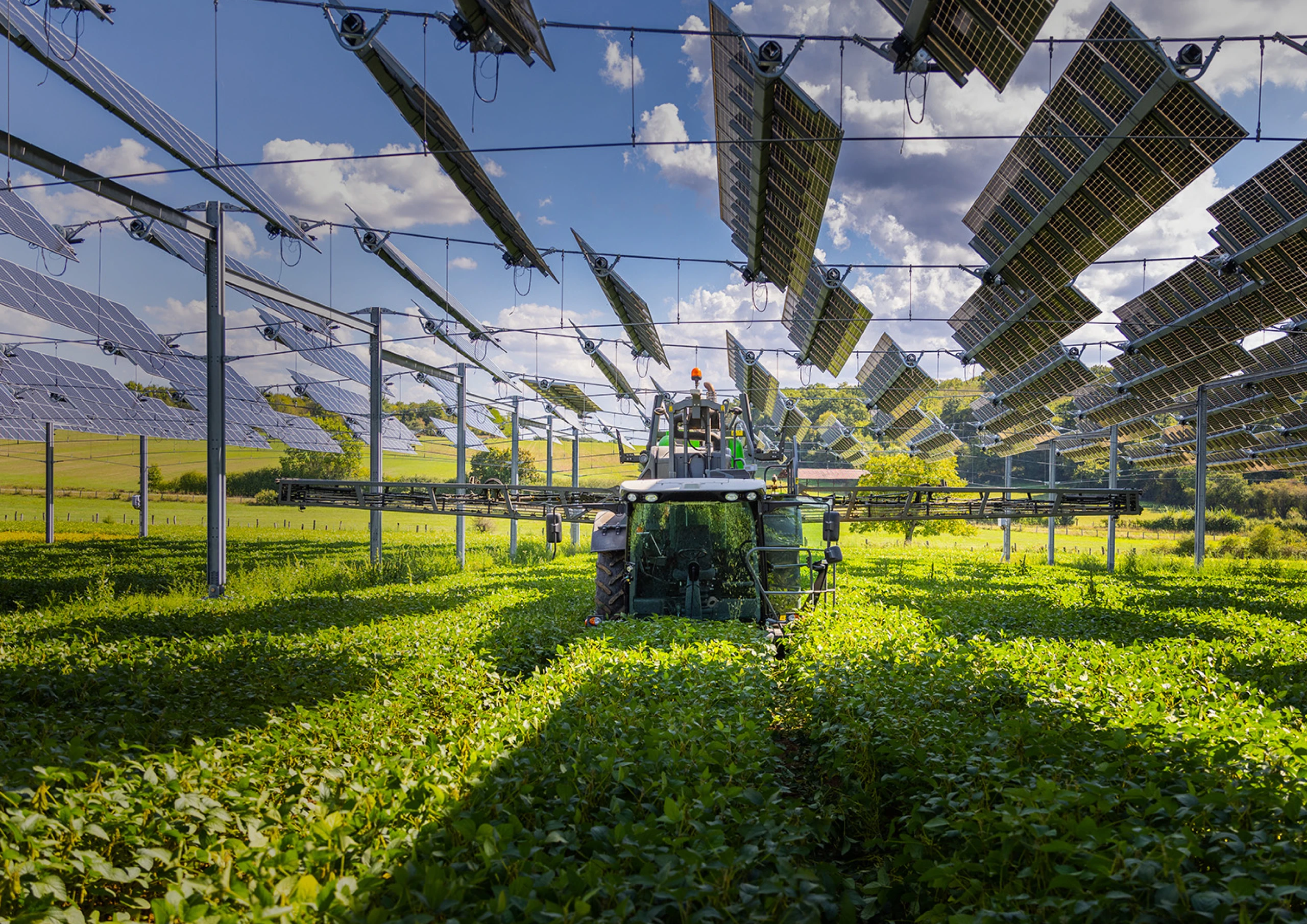
Agrivoltaic installations provide concrete support to agriculture, by protecting crops from extreme weather conditions, by reducing evapoperspiration, by improving animal comfort and by securing yields. They aim to improve the ability of agricultural systems to withstand the impacts of climate change.
Each project also contributes to the establishment of technical references for the agricultural sector. The experimental protocols conducted by INRAE and technical institutes enrich the knowledge available for the entire sector. Agronomic and ecological monitoring accompanies each project to complement and reinforce these technical references.
For each project, 70,000 to 80,000€ are devoted to technical and scientific studies, carried out most often by the Chambers of Agriculture and local design offices. All of this work contributes to reconciling goals of food and energy sovereignty of the country.
{{cta-custom-1}}
Agrivoltaics: a sustainable income supplement for farms
When agricultural markets are very unstable, agrivoltaics allows farmers to benefit from a long-term income supplement. Depending on the projects and developers, the farmer can collect on average between 2,000 and 4,000€ per hectare per year, in the form of rent or remuneration. Agrivoltaics therefore makes it possible to strengthen the financial stability of farms over the long term.
As evidenced by Benjamin and Fabienne Vion, farmers in Mayenne “It is a diversification for the farm, on a plot with low potential, with a project that remains at the service of agricultural production”.
{{cta-contact-agri}}
Agrivoltaic projects that strengthen fiscal resources in rural areas
Agrivoltaic projects bring tax revenue directly to communities. For example, a 10 MWp power plant can bring in around 22,500€ per year to the municipality and the intercommunality. For smaller installations, such as the 2.4 MWc one in Amance (Haute-Saône), the revenues are high at nearly €6,000 each year. In addition to supporting public services, these facilities increase the economic attractiveness of rural areas.
As underlined by Jean-Marie Bertin, Mayor of Amance “There is a concrete benefit for communities. Rural areas welcome these infrastructures, it is normal for them to benefit from a tangible return.”.
Local and competitive electricity production for the benefit of local actors
Thanks to collective self-consumption, agrivoltaics contributes to boosting the local economy. In Souleuvre-en-Bocage (Calvados), three companies thus benefit from electricity at a competitive price.
Individuals can also benefit from direct advantages: in some territories, TSE partners with an energy supplier to offer a “solar coupon”, offering €150 annual reduction over a period of 5 years.
How are the revenues from an agrivoltaics project distributed?
For an average income of around €40,000 per hectare per year, the breakdown is as follows:
- 9,000€ dedicated to operating expenses (maintenance, technical follow-up, site management).
- 23,000€ devoted to the reimbursement of investments and to the interests of financing.
- 3,000€ corresponding to taxes and duties.
- 3,000€ paid in the form of rent to the farmer and the landowner, guaranteeing a stable additional income.
- 2,000€ redistributed in dividends, once all costs have been covered.
This distribution illustrates in concrete terms: how agrivoltaics makes it possible to secure agricultural income, to finance sustainable infrastructure and to generate positive economic benefits for rural territories.
{{cta-contact-agri}}

.webp)